

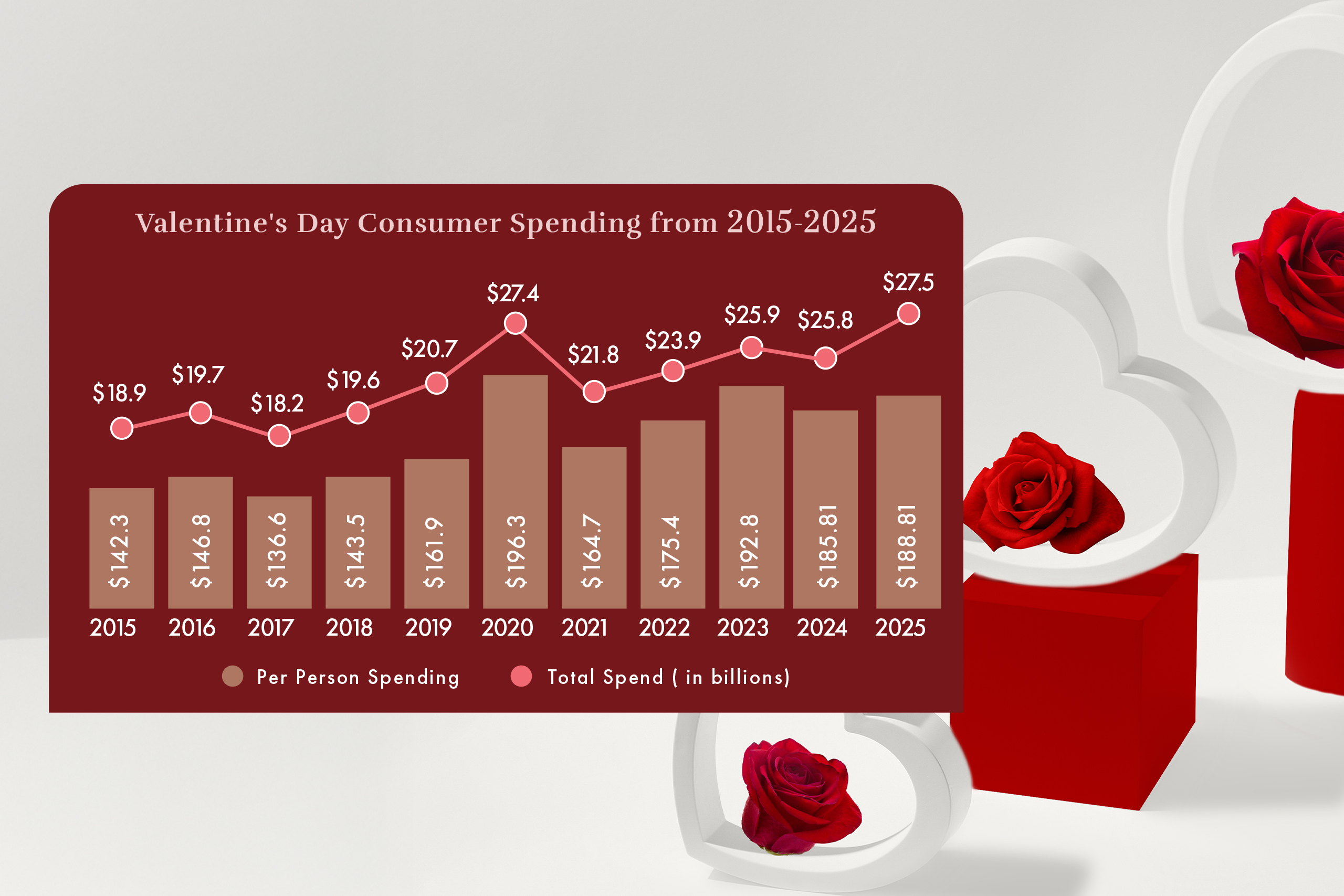
Valentine’s Day remains one of the most important holidays for consumers, and 2025 proved that the momentum isn’t slowing down. According to the annual survey by the National Retail Federation (NRF), Valentine’s Day spending reached a record $27.5 billion. That number is much higher than the prior year’s $25.8 billion and even edged out the previous high set in 2020.
Individual spending was also high, with consumers planning to spend an average of $188.81 per person. For the floral industry, these numbers reinforce the importance of Valentine’s Day as a cornerstone holiday.
Participation Is Increasing
More than half of consumers (56%) planned to celebrate Valentine’s Day in 2025, up from 53% the previous year. Men make up a large share of this, with 55% saying they planned to celebrate the holiday, up from 51% in 2024. Good news for florists: this gives you more opportunities to connect with shoppers with different budgets and needs.
Flowers Remain a Core Gift Category
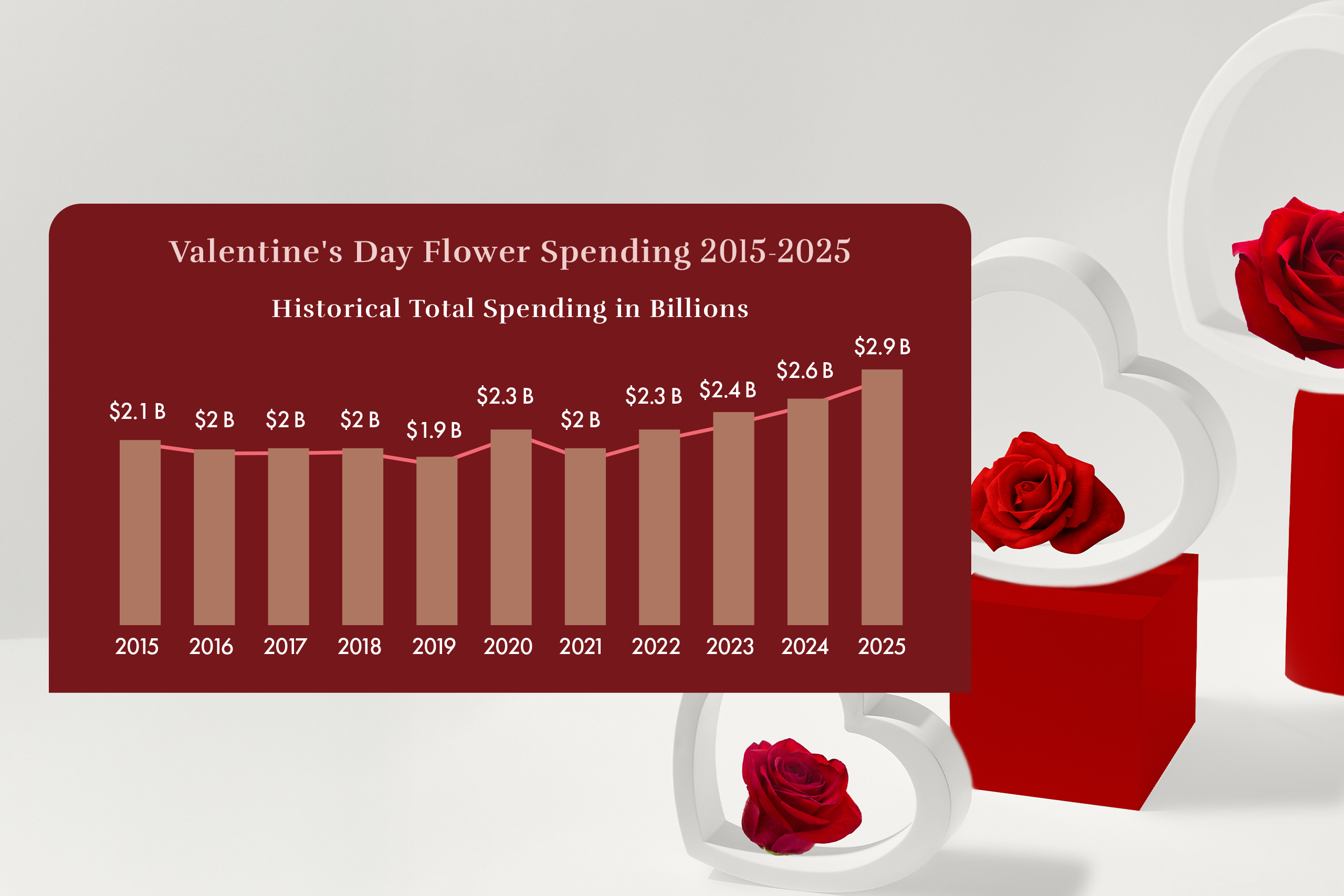
Flowers remain one of the most popular Valentine’s Day gifts, with 40% of consumers planning to buy them in 2025. Only candy and greeting cards ranked higher, but flowers have a greater emotional value. With a planned spend of $2.9 billion, flowers ranked with jewelry ($6.5B) and dining ($5.4B) as top Valentine’s Day categories. This highlights how flowers are key to consumers expressing love, appreciation, and connection on Valentine’s Day.
Gifting Is Expanding Beyond Romantic Partners
One of the most interesting trends is who consumers are shopping for.
• Spending on significant others reached a new record of $14.6 billion
• Spending on family members rose to $4.3 billion
• 32% of consumers planned to buy gifts for friends (the highest on record)
• 19% planned gifts for coworkers (also a record)
• 32% planned gifts for pets, consistent with recent years
This expansion shows that Valentine’s Day is no longer just about romantic love. It’s about celebrating all meaningful relationships. For florists, this widens the opportunity well beyond traditional red rose bouquets.
Where Consumers Are Shopping
Online shopping continues to lead Valentine’s purchasing, with 38% of people shopping on their phones, tablets, and laptops. Department stores followed at 34%, with florists and specialty stores accounting for 18% of purchases.
That 18% may seem small, but it’s a particular audience: customers who want expertise, quality, and emotional value. Those wanting something unique continue to rely on specialty floral retailers.
What This Data Means for the Floral Industry
Taken together, the 2025 Valentine’s Day statistics paint a clear picture:
• Valentine’s spending is growing, not contracting
• Flowers remain a top-tier emotional gift
• Consumers are gifting more broadly and more creatively
• Demand is coming from multiple relationship types, not just couples
This valuable insight into consumer trends can help you make the most of this holiday.
How Florists Can Leverage These Trends
Use this data to plan your Valentine’s Day offerings more intentionally:
• Diversify your arrangements to include friendship, family, and gratitude, not just romance.
• Categorize merchandise by recipient (partner, friend, coworker) to help customers make more confident choices
• Support early and online purchasing to align with consumer shopping behavior
• Communicate emotional value, not just price, reinforcing flowers as a meaningful experience
The record Valentine’s Day spending in 2025 backs up what we’ve always known: flowers are a powerful way to express emotion on this important day. With a clear understanding of consumer behavior and thoughtful planning, you can make this Valentine’s Day your most successful yet!